

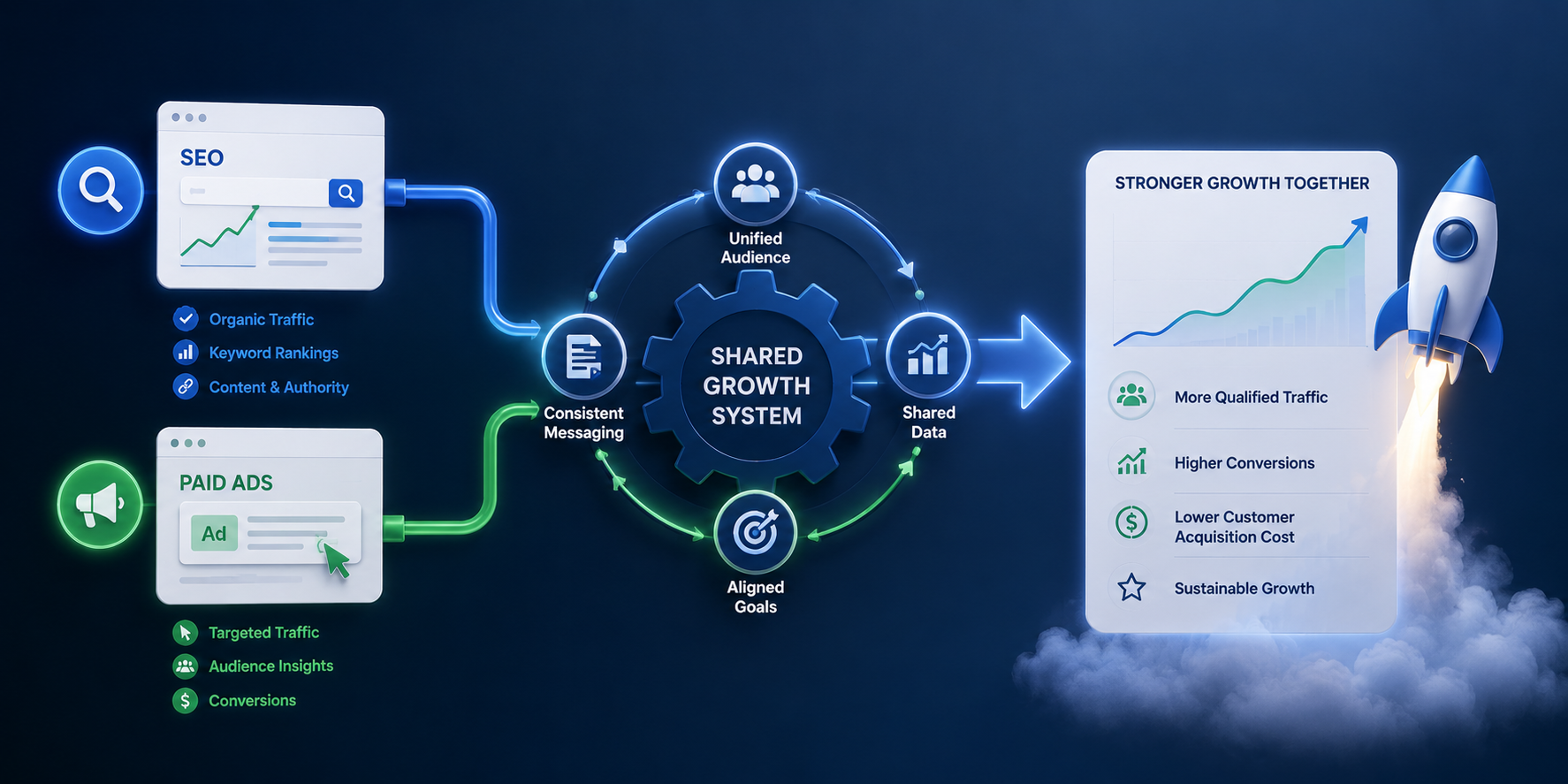
How SEO, Google Ads, social campaigns, landing pages, and analytics can work together instead of operating as disconnected marketing tasks.
Many businesses run SEO and paid advertising like two separate departments. One team focuses on rankings, the other focuses on clicks. The problem is that the customer does not experience them separately. The customer sees one brand, one message, and one path to action.
That is why SEO and paid campaigns perform better when they are supported by the same content strategy, conversion structure, and analytics framework.
SEO builds the foundation
SEO improves the long-term discoverability of the business. It helps prospects find service pages, blogs, location pages, and educational content when they are actively searching for solutions. Strong SEO also improves the quality of landing pages used for paid campaigns.
- Keyword strategy helps clarify what customers are actually searching for.
- Content depth improves topical authority and trust.
- Technical SEO improves crawlability, page speed, and user experience.
- Local SEO supports visibility for service-area and map-based searches.
Paid campaigns create controlled acceleration
Paid campaigns can generate faster visibility, but only when the click leads to a page built for conversion. Sending traffic to a weak page often wastes budget. The ad promise, landing page headline, proof points, and CTA must all match.
Shared analytics connects everything
The real advantage appears when SEO and paid campaigns are measured together. A shared dashboard can reveal which services attract the most interest, which pages convert, which keywords produce better leads, and where budget should be increased or reduced.
SEO Insight
Organic keyword and page data shows what users are naturally searching for and where content should be expanded.
Paid Insight
Campaign data shows which offers, geographies, and audiences can generate faster demand.
A connected system creates stronger decisions
When SEO, paid media, landing pages, and reporting are aligned, leadership can stop guessing. The business can see where traffic is coming from, what users are doing, and which marketing actions are producing measurable opportunities.
This is how digital marketing becomes a growth system rather than a collection of disconnected activities.
Suggested use: publish this as a blog page inside the website CMS and adjust the CTA or internal links as needed.